

When to use this
VIP customers
Enterprise customers need higher limits than your default tier.
Partners & integrations
Integration partners building on your API need room to grow.
Throttle abusers
Reduce limits for suspicious users without blocking entirely.
Testing & debugging
Temporarily increase limits for specific test accounts.
How it works
- You define default limits in your code
- Create overrides in the dashboard for specific identifiers
- When that identifier is rate limited, Unkey uses the override instead of the default
Create an override
Go to your namespace
Click Ratelimit in the sidebar → select your namespace → Overrides tab.If you don’t have a namespace yet, create one first.
Add the override
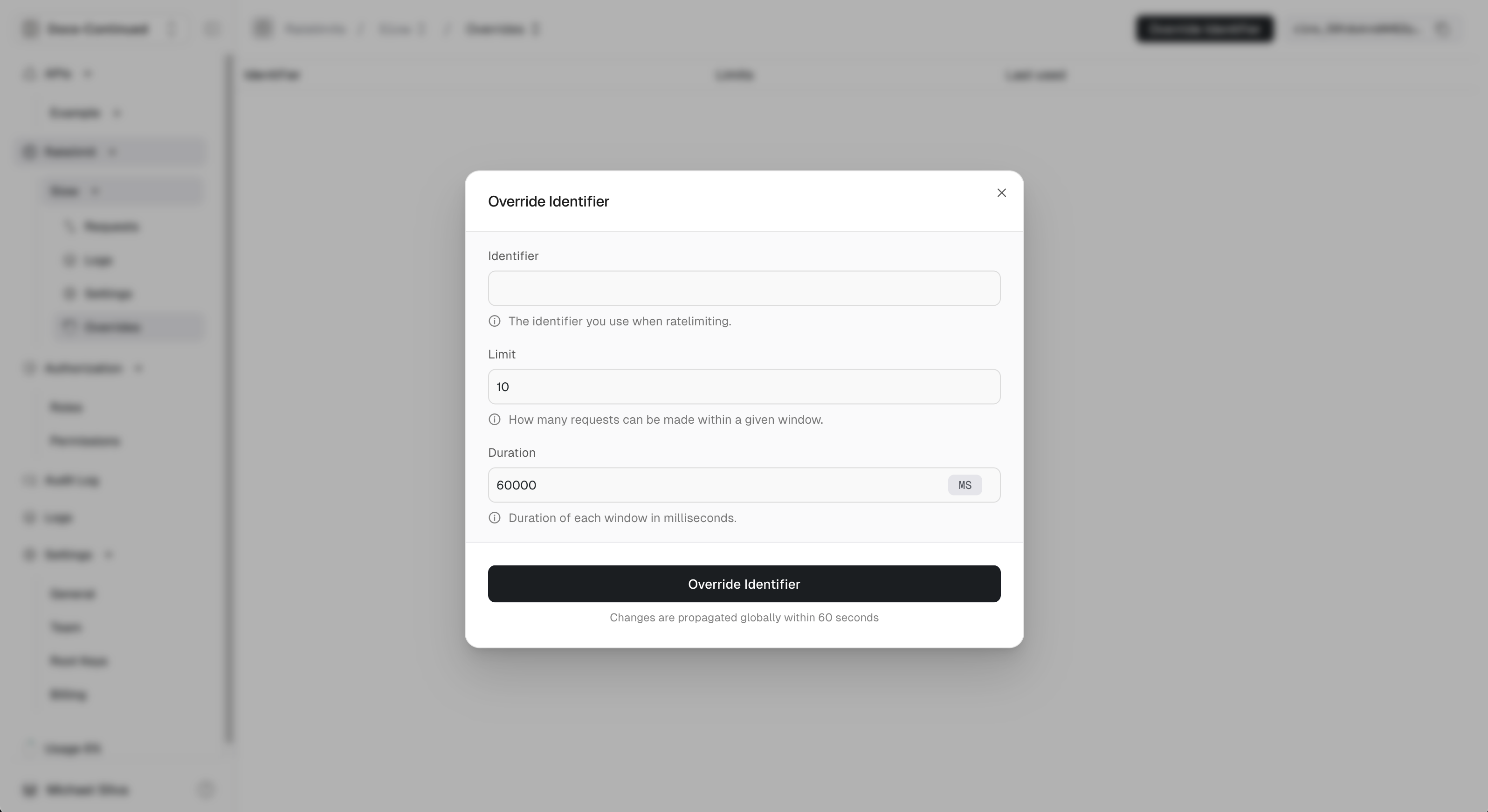
- Identifier: The exact identifier or wildcard pattern
- Limit: Custom request limit
- Duration: Time window for the limit
Example: Enterprise customer
Your default limit is 100 requests/minute. Acme Corp needs 10,000/minute.| Identifier | Limit | Duration |
|---|---|---|
acme-corp | 10000 | 60s |
acme-corp hits your API, they get 10,000/min instead of 100/min.
Wildcard patterns
Use* to match multiple identifiers at once.
Examples
| Pattern | Matches |
|---|---|
*@acme.com | alice@acme.com, bob@acme.com, api@acme.com |
enterprise:* | enterprise:123, enterprise:acme, enterprise:test |
user_*_prod | user_123_prod, user_abc_prod |
Priority
Exact matches always win over wildcards:| Override | Limit |
|---|---|
*@acme.com | 500/min |
ceo@acme.com | 10000/min |
ceo@acme.com→ 10,000/min (exact match)anyone-else@acme.com→ 500/min (wildcard match)user@other.com→ default limit

Managing overrides via API
Create overrides programmatically:- Automatically increasing limits when users upgrade
- Syncing limits from your billing system
- Temporary increases during promotions
Common patterns
Tier-based limits
${plan}:${userId}
Domain-based limits
Temporary boost
Need to give someone extra capacity for a demo or migration? Add an override, then remove it when done. No code changes needed.Removing overrides
Delete an override from the dashboard or API. The identifier immediately falls back to default limits (or the next matching wildcard).Next steps
How it works
Understand rate limiting architecture
Multi-ratelimits
Configure multiple limits per key